Handbook Introduction | Solar Guard Library
Preface | Part 1 | Part 2 | Part 3 | Contents |
Comments & suggestions may be sent to the Solar Guard Academy

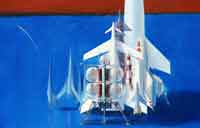
Spaceflight has been a subject of entertainment since the time of the ancient Greeks, and probably earlier. Naturally, what one calls "spaceflight" depends on the state of cosmology at the time. Spirits wandering among the planetae gave way to more mechanical notions of balloons or flocks of swans transporting the hero across the interplanetary aether.
As we saw in Part I, by the time the 20th Century dawned, the theory of spaceflight had advanced greatly and entertainers wasted no time in incorporating this new knowledge into their productions. Jules Verne’s From the Earth to the Moon took spaceflight out of the realm of fantasy forever with his science-based, if somewhat impractical, approach to getting to our nearest celestial neighbor. The story provided the basis for one of the first "blockbuster" productions in the brand new medium of motion pictures when the silver screen’s first great effects director, Georges Méliès, brought out his interpretation of the book in 1902.
As the century progressed, the amount of science, or at least an attempt at science, in fantasy novels increased. The American writer and editor, Hugo Gernsback called it "scientific fiction" (which he condensed to "Scientifiction" in the ‘20s) and the golden age of the pulps was born. "Scientifiction" never caught on as a term so it was separated back out to "Science Fiction" then later shortened to "Sci Fi" by the genre’s #1 fan, Forrey Ackerman.
Filmmakers, too, continued to expand and improve on their science/fantasy offerings. However, of the hundreds, perhaps thousands of Sci Fi films made this century, three stand out as milestones of "doing it right." While anything goes in a fantasy, if you are invoking science as the basis for your story, you are voluntarily placing restrictions on yourself to follow the rules. These three films followed the rules better than any others before or since because they all depicted space flight based on the best understanding of the problem at the time. Interestingly, they came out once per generation almost exactly 20 years apart just as society was poised on the cusp of a new era. The films are Die Frau im Mond (The Woman in the Moon, 1929) by Fritz Lang, Destination Moon (1950) by George Pal and 2001: A Space Odyssey (1968) by Stanley Kubrick and Arthur C. Clarke.
The reason that each "worked" was due to the experts hired as advisors, and the producers’ willingness to listen to them. Fritz Lang used none other than Hermann Oberth himself and watching the rocket sequences in Frau is like seeing Oberth’s Die Rakete come to life. George Pal used the one-two punch of Chesley Bonestell as science advisor and Robert Heinlein to oversee the hardware. Kubrick engaged the services of a whole staff of experts lead by Fredrick Ordway, a young associate of von Braun’s from Huntsville.
Sadly, these films may stand alone as testaments to spaceflight as it really is. Since we are now two generations into the Space Age, space flight per se is not a draw. With 2001, we have traveled nearly the entire solar system and to go beyond that, realistically, we move into the field of fantasy. Still, our knowledge of the cosmos continues to evolve and films along with it. The film Contact (1997) shows a realistic view of the possibilities of travel in this new era. As fantastic a concept as "The Machine" appears to us, it is no more so than a giant, three stage liquid fueled rocket taking off for the moon did to audiences in 1929. There’s nothing in its operation that violates the laws of the universe as we currently understand them. This was, again, due to the quality of it’s science advisor, and in this case also the author, Carl Sagan.