Handbook Introduction | Solar Guard Library
Preface | Part 1 | Part 2 | Part 3 | Contents |
Comments & suggestions may be sent to the Solar Guard Academy

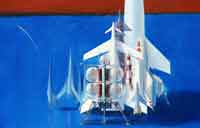
As the 20th Century opened, the spaceship was still very much in the realm of fantasy. While it’s true that Jules Verne made the first serious attempts to establish a scientific basis for space flight, his calculations were based on a comparatively primitive understanding of Newtonian mechanics and concepts of motion that happen in a straight line. The complex three dimensional billiards game that is true celestial navigation was unknown until an obscure Russian mathematics teacher, Konstantin Tsiolkovsky, began to apply the laws of thermodynamics to those of Newton and for the first time humanity understood what it really takes to get off the planet.
Unaware of Tsiolkovsky, a young Transylvanian physics teacher named Hermann Oberth chose the liquid fueled rocket as his doctoral thesis. He solved all of the same problems, and in far greater detail. The result was Die Rakete Zu Den Planetenräumen (The Rocket into Planetary Space), the fundamental 1923 work that is the spaceship’s birth certificate. This was followed six years later by Wege zur Raumschiffahrt (Ways to Spaceflight) which greatly expanded on the earlier work.
Getting his start under the direction of Oberth was the greatest German Missile Scientist of them all, Wernher von Braun. Von Braun was only 18 when he joined the fledgling Verein für Raumschiffahrt (Society for Space Travel) which had been founded by Oberth, Willy Ley and others. He went on, of course, to head the development team at Peenemünde that created the V2. As horrible as that weapon was, it was the first true spaceship, and after most of the team moved to the U.S. following the war, they filled the long, lonely nights in the New Mexico desert by dreaming engineers’ dreams of Mars.
These three men, along with the American Robert Goddard, are the founding fathers of the spaceship and space travel. They, along with many others, created the Space Age, which began at mid century.
Once the hardware was flying for real, there was a change. There were still plenty of theoreticians and dreamers, but now they worked in support of the real thing. The "won’t it be wonderful?" evangelism of the Collier’s series had done its job. Rather than saying "This is what a ship to Mars might look like" they were asking "How do we create a spacecraft that will survive eight months of interplanetary space and still be able to snap a few pictures of Mars as it passes?"
In this section, we will sail with these profound dreamers from the first stirrings of the human cosmic consciousness through the frantic early days of the Cold War.
It’s quite a ride.